Featured Post

CES 2019: The Future Looks Like These Robot Dogs Delivering Your Shopping To Your Doorstep

At CES, you can usually expect to see some cool stuff and some weird stuff. It's not very often that you see both in the same display, ...

Showing posts with label Space. Show all posts

NASA charts roadmap for human missions to Moon, Mars

The campaign has five strategic goals, including returning US astronauts to the surface of the Moon to demonstrating the capabilities required for human missions to Mars and other destinations.

NASA charts roadmap for human missions to Moon, Mars


Spaceflight, Outer space, Exploration of Mars, Exploration of the Moon, Government of the United States, NASA, Human spaceflight, Human missions to Mars, Human mission to Mars, Lunar outpost, the Orion, Texas, Congress, Alabama, MarsNASA said it intends to transition from the current model of human space activities in low-Earth orbit to a model where the government is only one customer for commercial services. (Image: NASA)
Revealing its human explorations plans, NASA has told the US Congress that the agency is currently focusing on developing technologies and systems that enable a series of human and robotic lunar missions that are extensible to Mars. The “National Space Exploration Campaign” that NASA submitted to the Congress on September 24 calls for human and robotic exploration missions to expand the frontiers of human experience and scientific discovery of the natural phenomena of Earth, other worlds and the cosmos, the US space agency said in a statement on Thursday.
The campaign has five strategic goals, including returning US astronauts to the surface of the Moon to demonstrating the capabilities required for human missions to Mars and other destinations. NASA said it intends to transition from the current model of human space activities in low-Earth orbit to a model where the government is only one customer for commercial services. The US space agency is building a plan for Americans to orbit the Moon starting in 2023, and land astronauts on the surface no later than the late 2020s.
A key component of establishing the first permanent American presence and infrastructure on and around the Moon is the Gateway, a lunar orbiting platform to host astronauts farther from Earth than ever before, NASA said. Some elements of the Gateway already are under construction at NASA centers across the United States, including facilities in Ohio, Texas and Alabama, and at commercial partner facilities. The Gateway will be assembled in space, incrementally, using the Orion spacecraft and SLS, as well as commercial launch vehicles. The first element, providing power and propulsion, will launch from Florida in 2022, NASA added in the statement.
The lunar surface will serve as a crucial training ground and technology demonstration test site where we will prepare for future human missions to Mars and other destinations,” NASA said, adding that by the late 2020s, a lunar lander capable of transporting crews and cargo will begin trips to the surface of the Moon. NASA said its series of crewed missions to Mars, planned to start in the 2030’s and culminating in a surface landing, would be supported by the work it does on the Moon in the coming years.

NASA working for better cancer treatments in space

In a new video published by the US space agency as part of the AngieX Cancer Therapy study, the team led by NASA astronaut Serena Aunon-Chancellor were shown examining endothelial cells that come from blood vessels.

NASA working for better cancer treatments in space

NASA, International Space Station, ISS cancer testing, NASA astronauts in ISS, ISS science experiments, chemotherapy effects, ISS cancer cells testing, blood vessels, space labsSeveral cartridge-shaped containers on board the ISS currently host the cells as they undergo varying amounts of chemotherapy exposure. (Image Source: YouTube/NASA)
Astronauts aboard the International Space Station (ISS) are conducting a blood cell experiment which may improve treatments for cancer, the media reported. In a new video published by the US space agency as part of the AngieX Cancer Therapy study, the team led by NASA astronaut Serena Aunon-Chancellor were shown examining endothelial cells that come from blood vessels.
Several cartridge-shaped containers on board the ISS currently host the cells as they undergo varying amounts of chemotherapy exposure. The team is conducting blood experiments in space because sometimes, cells act differently in the weightless environment of orbiting spacecraft, called microgravity. Because these orbiting cells perform more like they normally do inside the body, cancer researchers can more accurately test the cells for chemotherapy responses, the report said.
In the video, Aunon-Chancellor said the flat endothelial containers feel “all nice and warm and comfortable,” because they are kept at body temperature aboard the space lab. “We’ve had them for almost two months now up here in ISS. We feed them. We give them nutrients, they are like miniature crewmembers living with us.” According to NASA, endothelial cells housed within culture dishes (in vitro) in microgravity seem to perform as if they were in blood vessels within a living organism (in vivo) on Earth.
“The study may facilitate a cost-effective method that does not require animal testing, which may help develop safer and more-effective vascular-targeted drugs,” the project page on NASA stated.

NASA’s Spitzer telescope completes 15 years in space

Launched into a solar orbit in 2003, Spitzer has illuminated some of the oldest galaxies in the universe, revealed a new ring around Saturn, and peered through shrouds of dust to study newborn stars and black holes.


With its infrared vision and high sensitivity, Spitzer has contributed to the study of some of the most distant galaxies in the known universe. (Image Source: YouTube/NASA Jet Propulsion Laboratory)

 Spitzer telescope completes 15 years in space.

NASA’s Spitzer Space Telescope – which was initially scheduled for 2.5-year primary mission – has completed 15 years of space exploration. Launched into a solar orbit in 2003, Spitzer has illuminated some of the oldest galaxies in the universe, revealed a new ring around Saturn, and peered through shrouds of dust to study newborn stars and black holes. It assisted in the discovery of planets beyond our solar system, including the detection of seven Earth-size planets orbiting the star TRAPPIST-1, among other accomplishments.


"In its 15 years of operations, Spitzer has opened our eyes to new ways of viewing the universe,” said Paul Hertz, director of the Astrophysics Division at NASA Headquarters in the US. “Spitzer’s discoveries extend from our own planetary backyard, to planets around other stars, to the far reaches of the universe. And by working in collaboration with NASA’s other Great Observatories, Spitzer has helped scientists gain a more complete picture of many cosmic phenomena,” he said. With its infrared vision and high sensitivity, Spitzer has contributed to the study of some of the most distant galaxies in the known universe.
The light from some of those galaxies travelled for 13.4 billion years to reach Earth. As a result, scientists see these galaxies as they were less than 400 million years after the birth of the universe. In recent years, scientists have utilised Spitzer to study exoplanets, or planets orbiting stars other than our Sun, although this was not something the telescope’s designers anticipated.
Spitzer also played a key role in one of the most significant exoplanet discoveries in history: the detection of seven, roughly Earth-size planets orbiting a single star. The TRAPPIST-1 planetary system was unlike any alien solar system ever discovered, with three of its seven planets located in the “habitable zone,” where the temperature might be right for liquid water to exist on the planets’ surfaces. Their discovery was an enticing step in the search for life elsewhere in the universe.
“The study of extrasolar planets was still in its infancy when Spitzer launched, but in recent years, often more than half of Spitzer’s observation time is used for studies of exoplanets or searches for exoplanets,” said Lisa Storrie-Lombardi, Spitzer’s project manager at JPL. “Spitzer is very good at characterising exoplanets, even though it wasn’t designed to do that,” said Storrie-Lombardi. Spitzer has logged over 106,000 hours of observation time. 
Thousands of scientists around the world have utilised Spitzer data in their studies, and Spitzer data is cited in more than 8,000 published papers. Spitzer’s primary mission ended up lasting 5.5 years, during which time the spacecraft operated in a “cold phase,” with a supply of liquid helium cooling three onboard instruments to just above absolute zero.
The cooling system reduced excess heat from the instruments themselves that could contaminate their observations. This gave Spitzer very high sensitivity for “cold” objects. In July 2009, after Spitzer’s helium supply ran out, the spacecraft entered a so-called “warm phase.” Spitzer’s main instrument, called the Infrared Array Camera (IRAC), has four cameras, two of which continue to operate in the warm phase with the same sensitivity they maintained during the cold phase.


10 Really Weird But Fascinating Things That Exist In Space

Space has fascinated people for centuries and continues to do. There's not a single soul that doesn’t look up at the sky, and not wonder what lies beyond it. We think about different galaxies, stars and alternate worlds. It's fascinating. To peak your curiosity just a little bit, here's a list of a few things that actually exist in space, and it will make you feel small, really small.
10 Really Weird But Fascinating Things That Exist In Space

1. Blind Willie Johnson's Voice Echoes Through Space

The twin spacecraft Voyager 1 and Voyager 2 were launched by NASA in separate months in the summer of 1977 from Cape Canaveral, Florida. The spacecraft is carrying on board a record with pictures and sounds from the Earth.
has messages in fifty languages, There's also music travelling through space. The sonchosen was Blind Willie Johnson,an American gospel blues singer from the 1920s. His song
'Dark was the night, could was the ground', as it was thought to represent humanity as a whole.

2. Pareidolia

Space
Pareidolia is a psychological phenomenon involving a vague and random stimulus, often an image or sound being perceived as significant. And in space people images of everyday objects from Earth in other planets.
For example, a spacecraft orbiting Mars sent back an image that looked like the Star Fleet emblem from the movie Star Trek. Some even thought the formation looked a lot like a flock of birds in formation.

3. Mira

Mira is the Latin name for a star which literally translates to amazing. This star’s diameter is 700 times that of our sun. Mira's supernatural properties were discovered only recently. It's found in the constellation of Cetus.  The star peaks in brightness and then fades into oblivion, repeatedly.
A few years ago, NASA's Galex satellite discovered that Mira's discarded gases form a comet-like tail.

4. Hypervelocity Stars


According to Centre for Astrophysics study, in  2005, Smithsonian astronomers discovered a star has been thrown out of the Milky Way and drifts in the emptiness of intergalactic space. This star gives an insight into the nature of stars that orbit close to a black hole.

5. The Smell of Raspberries and Rum

Space

In space, there’s a cloud named Sagittarius B2 that astronauts say, smells like raspberries and rum!  The cloud apparently is made of ethyl formate, which is the chemical composition which give raspberries that tangy taste and rum its strong smell. Sounds trippy, doesn't it?

6. Parking Lot

Space
Apart from strolling around the moon, Neil Armstrong may have spotted a UFO parking lot in space . In his words they were 'lined up on the far side of the crater's edge!' Weird or what?

7. Fire Burn Without a Flame

Space
YOUTUBE

One of the weirdest things astronauts discovered in space is the peculiar way fire behaves. According to a report in Space.com, FLEX researchers ignited a small drop of heptane or methanol fuel in a special experiment rack aboard a space station.
Forman Williams, the project leader on the experiments, told Space.com, "Thus far, the most surprising thing we've observed is continued apparent burning of heptane droplets after flame extinction under certain conditions. Currently, this is entirely unexplained."

8.  Glass Domes on the Moon

Space
REUTERS
There are some strange theories that say astronaut, Alan Bean saw glass domes from a long-extinct alien civilization on the moon. In an interview, Bean described the space as looking like "black, patent-leather shoes" from the surface of the moon. It was as though he was seeing space through the reflection of a glass dome.

 9. The Diamond Planet

It's an alien planet thought to be made largely of diamonds. That's right,  it's a huge rock! Scientists reported that the star at the center of a solar system 40 light years from our own had a carbon-to-oxygen ratio greater than one.  The alien planet, a so-called "super-Earth," is called 55 Cancri e and was discovered in 2004 around a nearby star in our Milky Way galaxy.

10. Rogue Planet

This planetary-mass object that orbits a galactic centre directly, it never has a set path. More recently, a strange 200 million-year-old object with the mass of a planet has been discovered 20 light years from Earth, outside our solar system. It produces an unexplained glowing aurora and travels through space alone, without a parent star.

There's A Massive Patch Of Space With Few Galaxies, But Scientists Still Can't See Through It

There's A Massive Patch Of Space With Few Galaxies, But Scientists Still Can't See Through It.
In space, nothing is ever as it seems. We’ve constantly had to reform old hypotheses to fit new discoveries, and that might be happening again right now. You see, scientists have discovered a patch of supposedly empty space that they still can’t see through.
galaxy
Scientists form the University of California have been studying a 300-million-light-year-long region of space, in front of the ULAS J0148+0600 quasar (very remote celestial objects that emit large amounts of energy for no discernible reason). This space somewhat blocks the light from the quasar coming towards Earth, and yet it seems to have fewer galaxies than expected, which is counter-intuitive.
And yet, it’s discrepancies like this that help scientists better understand the mysteries of our universe. You see, astronomers monitor the “Lyman alpha” emissions of a distant object in order to study them. This is light emitted by hydrogen atoms with a specific wavelength. As that light is crossing the light years, the universe is constantly expanding, so this wavelength stretches along the way. But neutral atoms in between can actually absorb the light and make certain wavelengths disappear before they reach Earth. This way, scientists can plot the missing pieces and create a timeline of what happened in between.
galaxy
Specifically, electrically charged gas absorbs the Lyman Alpha light, but ionized gas does not. Around us right now, there’s about a uniform distribution of ionized gas thanks to all the available ultraviolet light, but scientists believe things weren’t always so uniform in space. That means some places with tighter clusters of galaxies had more ionized gas, and were therefore more transparent. In other places, like near this particular quasar, there might have been fewer galaxies, so less ionized gas, and therefore it was more opaque when the light left the quasar billions of years ago.
This discovery flies in the face of current astrophysicist belief, which is that the number of galaxies in each region should be uniform. Here, they are clearly not. The only current hypothesis is that, as some stars exploded earlier than others and spread ionized gases, parts of our universe changed before others.
In any case, it’s just another mystery researchers are keen to sink their teeth into. 

Scientists Use ‘Light-Fingerprints’ to Reveal Mysteries of the Cosmos


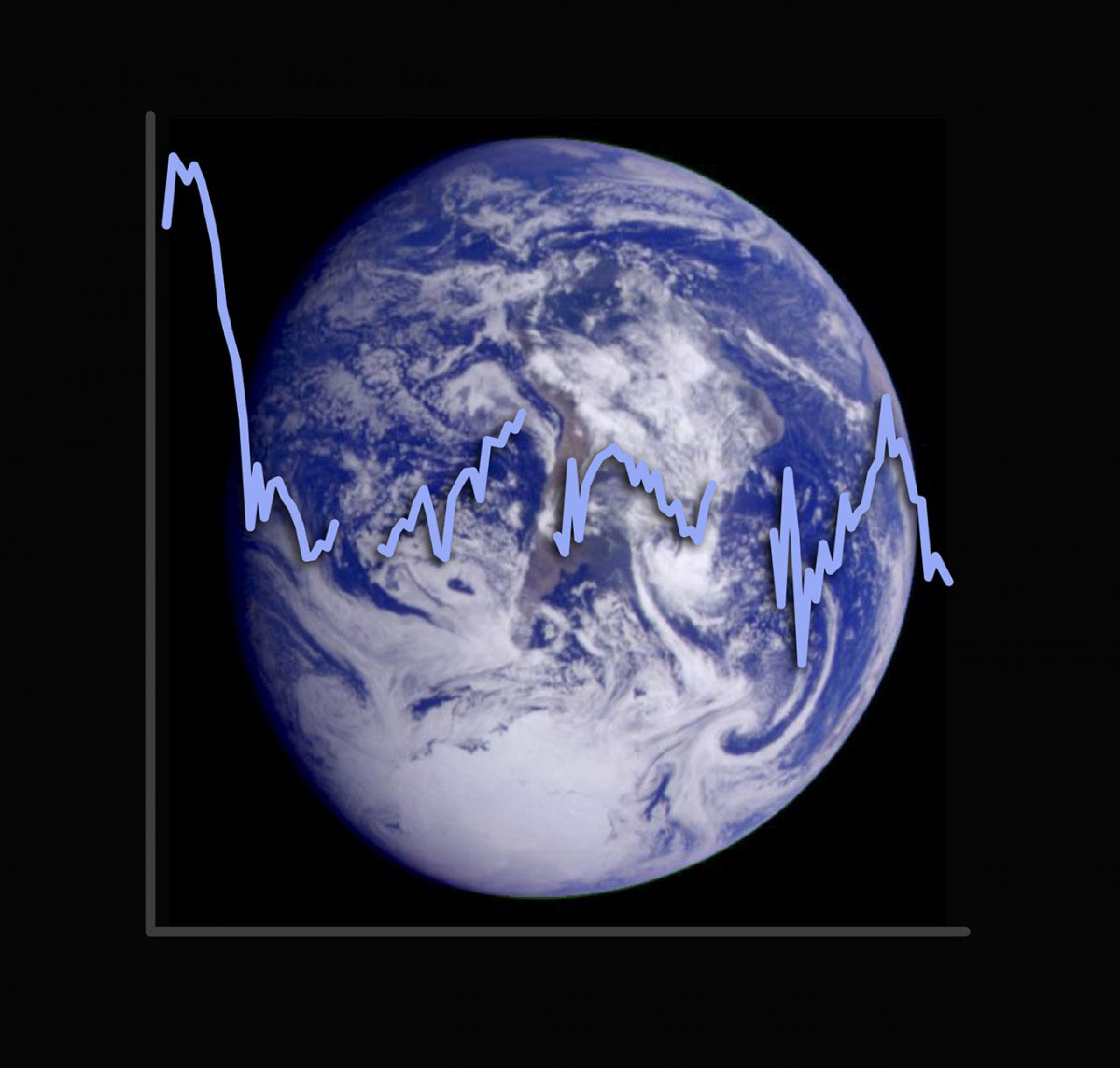
Earth with the albedo plotted over it. Jack Madden/NASA
Earthbound detectives rely on fingerprints to solve their cases; now astronomers can do the same, using “light-fingerprints” instead of skin grooves to uncover the mysteries of exoplanets.
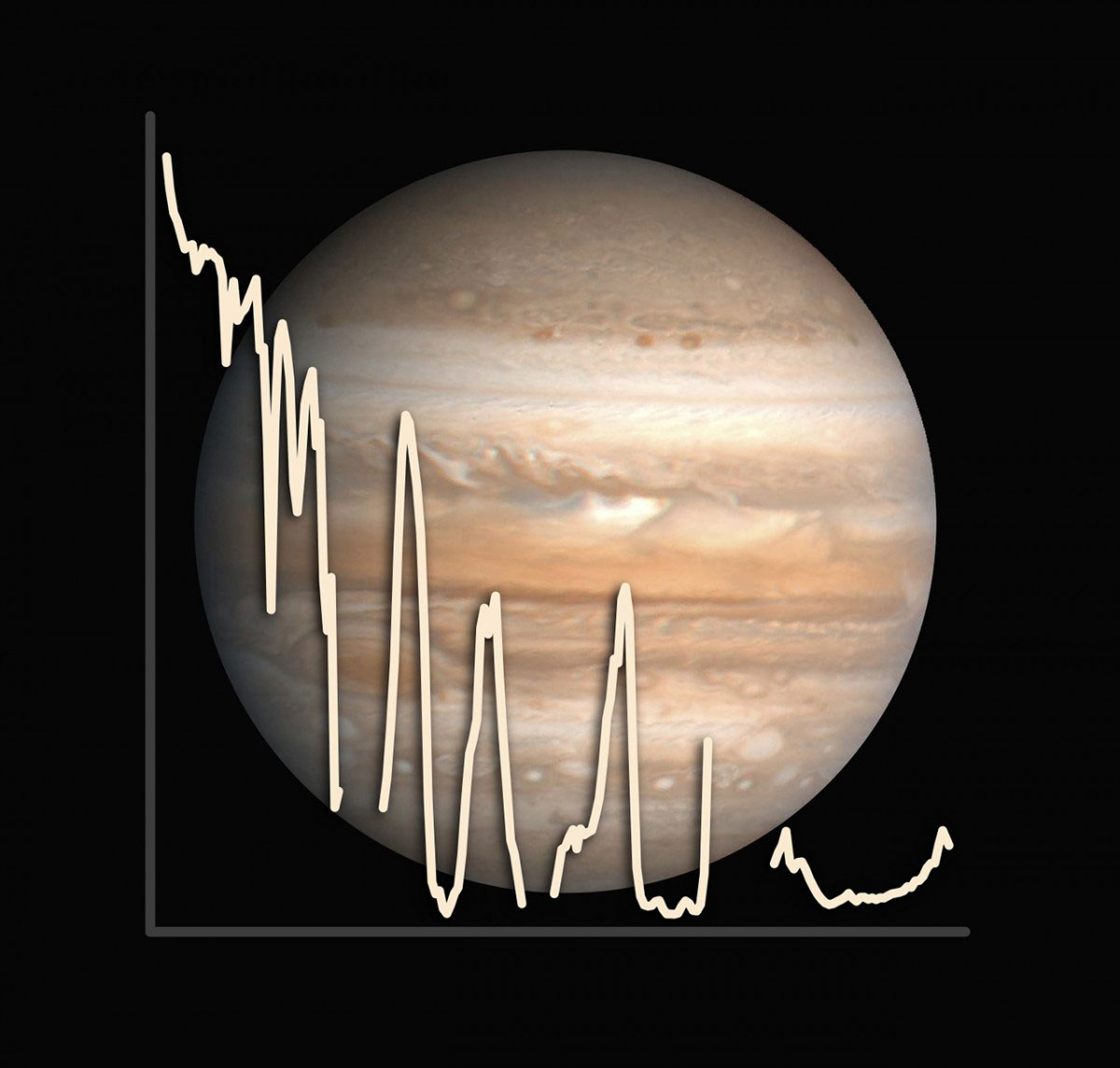
Cornell researchers have created a reference catalog using calibrated spectra and geometric albedos (the light reflected by a surface) of 19 of the most diverse bodies in our solar system: all eight planets, from rocky to gaseous; nine moons, from frozen to lava spewing; and two dwarf planets, one in the asteroid belt (Ceres) and one in the Kuiper belt (Pluto).
By comparing observed spectra and albedos of exoplanets to this catalog of our own home planetary system, scientists will be able to characterize them in reference to the wide range of icy, rocky and gaseous worlds in our home system.
“A Catalog of Spectra, Albedos and Colors of Solar System Bodies for Exoplanet Comparison” was published online July 31 in the journal Astrobiology and will be featured on the print edition’s cover in December.

Jupiter with the albedo. Jack Madden/NASA
“We use our own solar system and all we know about its incredible diversity of fascinating worlds as our Rosetta Stone,” said co-author Lisa Kaltenegger, associate professor of astronomy and director of the Carl Sagan Institute. “With this catalog of light-fingerprints, we will be able to compare new observations of exoplanets to objects in our own solar system – including the gaseous worlds of Jupiter and Saturn, the icy worlds of Europa, the volcanic world of Io and our own life-filled planet.”
The catalog, freely available on the Carl Sagan Institute website, includes high- and low-resolution versions of the data, which shows astronomers the influence of spectral resolution on an object’s identification. In addition, the catalog offers examples of how the colors of the 19 solar system models would change if they were orbiting stars other than our sun.
“Planetary science broke new ground in the ’70s and ’80s with spectral measurements for solar system bodies. Exoplanet science will see a similar renaissance in the near future,” said Jack Madden, doctoral candidate at the Carl Sagan Institute and lead author of the study. “The technology to directly collect the light from Earth-sized planets around other stars is currently in a clean room waiting to be assembled and trained on the right target. With the upcoming launch of the James Webb Space Telescope and the current construction of large ground-based telescopes such as the Giant Magellan Telescope and the Extremely Large Telescope, we are entering a new age of observational ability, so we need a reference catalog of all the planets and moons we already know, to compare these new exoplanet spectra to.”
The catalog will enable scientists to prioritize time-intensive, high-resolution observations of extrasolar planets and moons. It also offers insights into what kind of worlds won’t be so easy to categorize without high-resolution spectra. For example, Venus is a rocky planet, but because sunlight reflects from its dense carbon dioxide atmosphere rather than its rocky surface, the colors astronomers observe from such a planet are similar to those of an icy world. On the outer edge of the habitable zone, rocky exoplanets are likely to have dense atmospheres like Venus. Such worlds will require long observations to characterize correctly.
“Examining our solar system from the vantage point of a distant observeris an illuminating exercise,” said Madden.
“By unraveling the mysteries of the objects in our own solar system we can glimpse the secrets of these new worlds we are finding,” said Kaltenegger. 

Mars is the closest it’s been to Earth in 15 years: How to watch, timings, and more

Mars, Mars closest distance to Earth, how to watch Mars closest distance to Earth, Mars Earth closest, Mars closest to Earth date and time, Mars planet, Red Planet brightest view, Mars Opposition, Mars today, Martian surface, Mars near Earth, Mars dust storm, Red Planet newsMars gets closest to Earth; date and time, how to watch, what to expect: Mars will be at its closest distance to the Earth during an Opposition phase, a phenomenon that occurs about once in every 15 years. (Image Source: NASA)
Mars will be closest to Earth on Tuesday, a phenomenon that occurs once in every 15 years. The phenomenon takes place whenever the red planet reaches its position of ‘opposition’, when Earth is between Mars and the sun.  This year, Mars’ opposition took place at the same time the blood moon was visible on July 27. When the planet reaches its closest distance from Earth later today, it allows stargazers to see it in its brightest form.
Here is when and how users can get the best view of Mars, and why this opposition is different from its previous versions.

Mars gets closest to Earth on July 31: What is Mars’ opposition?

Each planet has its own orbit around the sun, and takes a fixed time to complete a revolution around it. But because the distance of each planet from the sun differs, the time taken by each planet to revolve around the star varies. Earth takes roughly a year (or 365.25 days, to be exact) to complete a revolution around the sun, while Mars does it in 1.88 years (approximately 687 days). Since the orbits of the two planets are of different lengths, they come close to each other once every two years. The last time Mars came close to Earth was in 2016.
In some cases, as the two planets get closer to each other, the Earth – being closer to the sun – comes between the star and the red planet. In this case, Mars appears opposite the sun, and is said to be in ‘opposition’. During opposition, a planet will appear larger than usual, and its brightest colours are visible. In the case of Mars, its brightest shades of red or orange will be visible.
The last time Mars was close to Earth was in 2003, when the red planet came within 34.6 million miles (55.7 million km) of our planet. It was the closest Mars had been to Earth in 60,000 years, according to NASA. Today, the planet will be at a distance of 35.8 million miles (57.6 million km) from Earth.
This phenomenon is expected to occur next in 2034. This year’s opposition took place during the total lunar eclipse and blood moon, making the red planet appear dim. The moon and Mars were visible beside each other, and both celestial bodies were visible in shades of red.

Mars gets closest to Earth on July 31: Date and time, how to watch

On the evening of July 31, and the planet will be seen rising from the Gemini constellation in India and you will be able to see it with the naked eye. To view specific details of Mars’ surface, stargazers can view the planet through a telescope.
Mars, Mars closest distance to Earth, how to watch Mars closest distance to Earth, Mars Earth closest, Mars closest to Earth date and time, Mars planet, Red Planet brightest view, Mars Opposition, Mars today, Martian surface, Mars near Earth, Mars dust storm, Red Planet newsNASA has captured many images of the planet-wide dust storm that has been affecting Mars since June this year. (Image Source: NASA)
There is presently a planet-wide dust storm on Mars, a phenomenon that is said to occur when the planet is closest to the sun in its orbit. So not many features of the red planet may be visible today.
If the weather is a problem at your location due to the monsoon, you can view NASA’s live stream of the Mars sighting from the Griffith Observatory. The live stream can be found on the space agency’s website, or NASA’s YouTube channel from 1.30pm EST (around 11pm IST). The broadcast will continue till 4pm EST (1.30am IST on August 1).
Mars will next be close to Earth in October 2020. At the time, Mars and Earth will be 38.6 million miles (62.1 million km) apart.

NASA’s new planet hunting probe, TESS, begins operations

NASA's TESS (Transiting Exoplanet Survey Satellite) probe will now take over the mantle to find new planets in the vicinity of our solar system. 

NASA, NASA TESS probe, NASA planet seraching spacecraft, TESS exoplanet probe, NASA 2018 missions, TESS mission date, habitable planets, solar systems, eoxplanet discoveryNASA’s latest planet hunting probe – the Transiting Exoplanet Survey Satellite (TESS) – has started its search for new worlds around nearby stars, the US Space agency said. (Image Source: NASA)
NASA’s latest planet hunting probe – the Transiting Exoplanet Survey Satellite (TESS) – has started its search for new worlds around nearby stars, the US Space agency said. TESS is expected to transmit its first series of science data back to Earth in August, and thereafter periodically every 13.5 days, once per orbit, as the spacecraft makes it closest approach to Earth. The TESS Science Team will begin searching the data for new planets immediately after the first series arrives.
“I’m thrilled that our planet hunter is ready to start combing the backyard of our solar system for new worlds,” said Paul Hertz, NASA Astrophysics division director at Headquarters, Washington. “With possibly more planets than stars in our universe, I look forward to the strange, fantastic worlds we’re bound to discover,” said Hertz. TESS is NASA’s latest satellite to search for planets outside our solar system, known as exoplanets.

1m 52s

NASA's Actual Plan to Save the World from Asteroids
NASA wants to smash a satellite into an asteroid, and it's all in the name of saving Earth from future catastrophic space rock collisions.

The mission will spend the next two years monitoring the nearest and brightest stars for periodic dips in their light. These events, called transits, suggest that a planet may be passing in front of its star. TESS is expected to find thousands of planets using this method, some of which could potentially support life.